Technology used to mean building websites, applications, or software — tools that waited for someone to open them, click a button, and tell them what to do next. That era isn't over, but a new one is beginning alongside it. Digital systems are starting to understand context, make decisions, automate processes, learn from data, and work alongside the people who use them. This is the world of intelligent and agentic systems, and it's where I do my work.
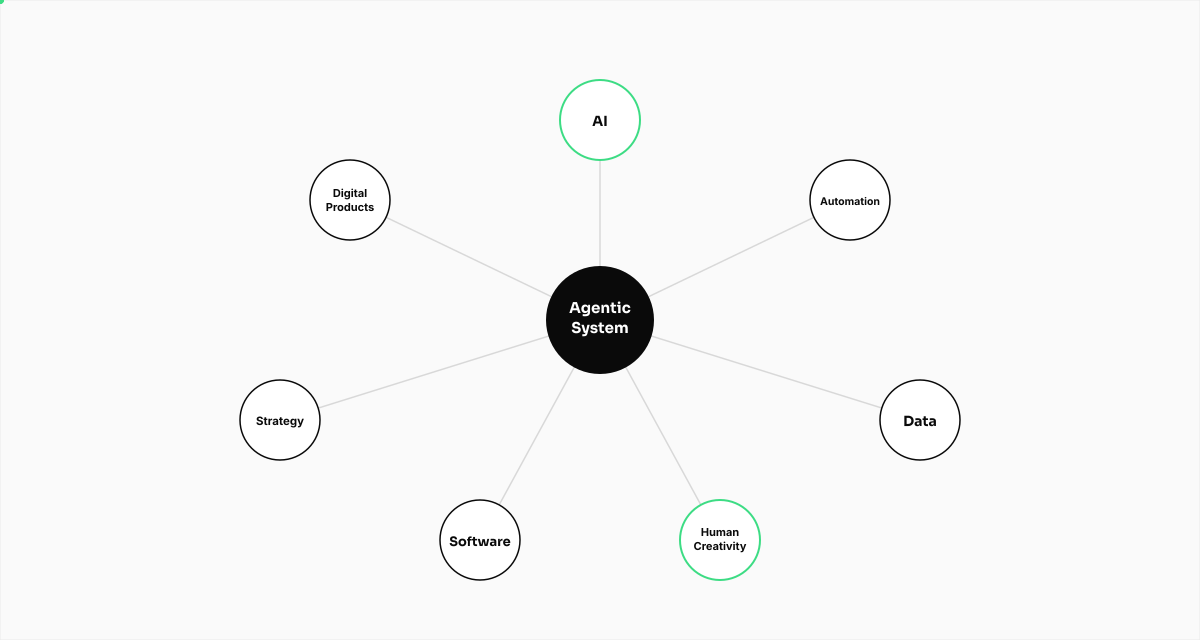
As an Agentic Systems Architect, I build intelligent digital ecosystems — places where AI, software, automation, data, and human creativity meet to solve real problems and open up new opportunities.
From Software to Smart Systems
Traditional software has always been reactive. You give it an input, it waits, then it responds. Intelligent systems change that relationship: they can read a situation, analyze what's happening, and help make better decisions before anyone has to ask. Agentic systems go further still, giving software agents goals of their own — the ability to coordinate tasks, use tools, talk to other systems, and carry out entire workflows with real autonomy.
None of that happens by simply dropping an AI model into an existing application. It takes a deliberate architecture. The real work is combining AI with dependable software, structured data, automation, APIs, business logic, security, and thoughtful user experience — with a human still watching over the whole thing. I don't think of these as separate technologies bolted together. I think of them as one ecosystem, designed to work as a whole.
Turning Ideas Into Digital Intelligence
Every good product starts as an idea. But an idea only matters once it becomes a system that actually works in the real world. My work spans AI, agentic systems, intelligent software, automation, digital products, software architecture, technology strategy, and marketing innovation — all in service of turning ideas into digital experiences people can actually use.
Whether it's a productivity tool, a business platform, a developer utility, an automated workflow, an intelligent assistant, or something bigger — a whole digital ecosystem — the goal never changes: build technology that's useful, adaptable, and able to prove its value.
Where Humans and AI Work Together
I don't believe the future of technology is about replacing human creativity. It's about amplifying it.
AI is very good at processing huge amounts of data, spotting patterns, automating repetitive tasks, and supporting complex decisions. People bring something AI can't: imagination, empathy, strategic thinking, intuition, and a sense of purpose. The strongest systems I've built are the ones that let both do what they do best.
That's why I approach architecture from a technical angle and a human one at the same time. A system can be as sophisticated as you like, but it also has to be understandable, accessible, and genuinely useful to the people and businesses depending on it.
Inspiring Success Through Innovation
The organizations that win in this new AI era won't be the ones running isolated experiments. They'll be the ones that learn to connect everything into a real, working intelligent ecosystem. Helping make that transition is a big part of what I do.
I build systems that turn complexity into opportunity — from designing digital products to architecting intelligent workflows, from automating day-to-day operations to exploring what autonomous agents can do next.
From ideas to intelligence.
From software to systems.
From automation to autonomy.
The next wave of digital innovation is happening right at the intersection of AI, software, data, automation, and human creativity. That's where I'm building — and where I hope to inspire the people and organizations building alongside me.

Written by Suman Kumar Phuyal
World Record Holder & Agentic Systems Architect building intelligent digital ecosystems for businesses in 21+ countries. View full profile →